Awards
Awards


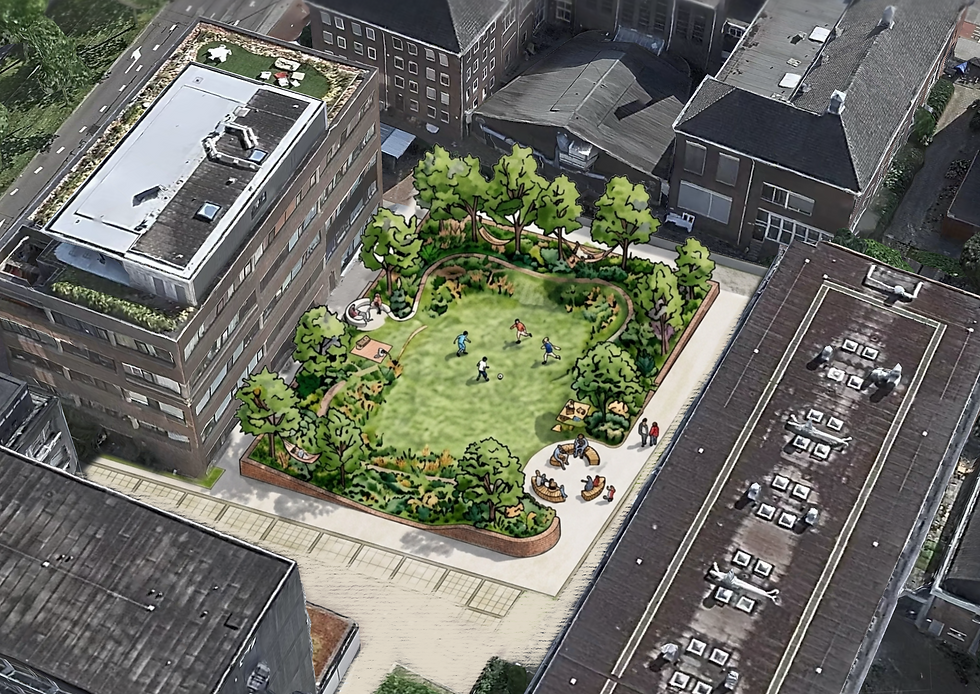

Data Driven Landscapes
A parametric workflow to reduce vulnerability to urban floods and heatwaves
Student:
Mentors:
Sana Hafsa
Simona Bianchi (AE+T)
Daniela Maiullari (Urbanism)
External mentors: Buro Happold
More information:
Urban neighbourhoods face pluvial flood and heatwave risks which can be tackled using blue green infrastructure (BGI), yet existing BGI design tools cannot parametrically evaluate multi-hazard performance at the design stage. This thesis develops an integrated parametric workflow combining FastFlood and ENVI-met within Grasshopper, enabling systematic variation of BGI parameters across trees, shrubs, surfaces, and water bodies, with simultaneous assessment of flood depth, flow velocity, and daytime/evening thermal comfort. Performance is structured through the IPCC risk framework (flood sensitivity, heat sensitivity, and adaptive capacity) to identify which parameters most influence outcomes and under what conditions.
Results show surface roughness dominates flood performance while trees dominate daytime heat mitigation, with clear trade-offs between hazard domains, confirming BGI design cannot be reduced to single-hazard optimization. A TOPSIS-based multicriteria framework translates this evidence into comparative design guidance, demonstrating that strategy preferences are sensitive to criterion weights, particularly when adaptive capacity indicators are included.
The thesis concludes that a parametric BGI workflow is both feasible and necessary, offering a replicable methodology for evidence-informed, climate-adaptive urban design.